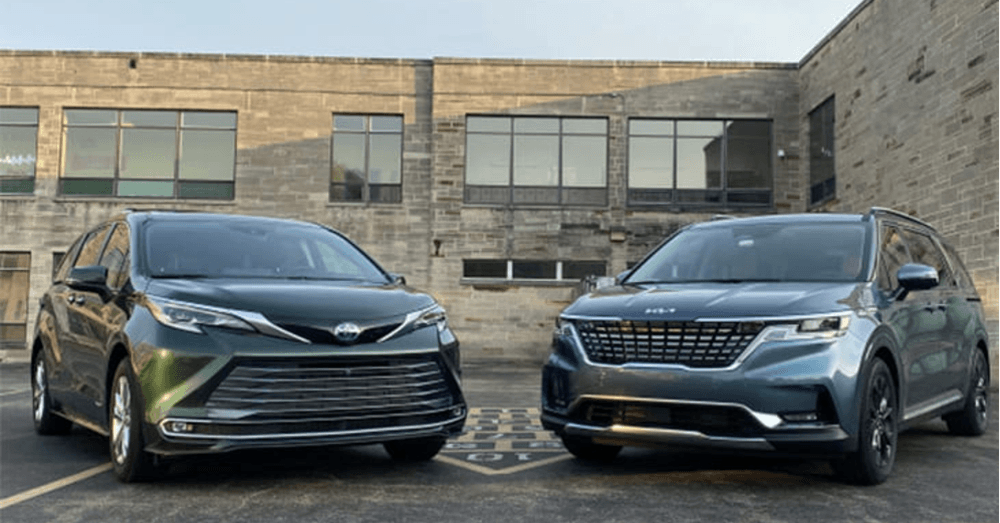
The minivan aisle just got a lot shorter. With the Chrysler Pacifica’s plug-in hybrid option now gone, the 2026 Kia Carnival and 2026 Toyota Sienna are the only remaining hybridized minivans on the market. Both promise the kind of fuel economy families used to dream about, but they go about it in very different ways.
- Toyota’s Sienna offers better EPA fuel economy and available all-wheel drive
- Kia’s Carnival Hybrid wins on cargo space, tech, and lounge-style seating
- Starting prices sit within about $1,000 of each other
Powertrains and Performance
These two vans are closer than you’d think under the hood. The Sienna pairs a 2.5-liter four-cylinder engine, a CVT, and two electric motors for a combined 245 horsepower, and adding all-wheel drive bolts on a third electric motor that spins the rear wheels without changing output.
Kia takes a punchier route. The 2026 Carnival Hybrid uses a turbocharged 1.6-liter four-cylinder paired with an electric motor, making around 242 hp and 271 lb-ft of torque through a 6-speed automatic, and it’s front-wheel drive only. More torque gives the Kia a little extra shove when you’re loaded up with kids and gear. Still, the Toyota’s hybrid system feels more refined, especially under hard acceleration, and Sienna buyers can pick front- or all-wheel drive while the Carnival sticks with front-wheel drive only.
Fuel Economy in the Real World
Official numbers favor Toyota. The Sienna posts 36 mpg across the board for the FWD model and 34 city, 36 highway, and 35 combined for AWD versions. The Carnival Hybrid comes in at an EPA-estimated 34 mpg city and 31 mpg highway, or roughly 32 combined.
That said, in Edmunds’ real-world testing, both models topped 40 mpg, outperforming their window stickers. So the gap closes once you’re actually on the road. If you crave snow-day confidence, though, AWD is a deciding factor, and only the Sienna offers it.
Interior Space and Family Features
If you haul stuff more than people, the Carnival runs away with this one. The 2026 Kia Carnival offers 40.2 cu ft behind the third row, 86.9 cu ft behind the second, and 145.1 cu ft behind the first, while the 2026 Toyota Sienna measures 33.5, 75.2, and 101 cu ft. That’s a huge gap when the family starts piling in Costco runs and hockey bags.
Both vans seat seven or eight. Toyota uses conventional captain’s chairs in seven-passenger models, while Kia offers power lounge-like seats with pop-up legrests and generous recline, though those chairs only reach full recline when slid all the way back, eating into third-row room, and even then they really only fit kids comfortably. Worse, those fancy seats can’t be removed, which chips away at the Carnival’s hauling edge.
On the tech front, an eight-inch touchscreen is standard on the Carnival with available dual 12.3-inch displays, Apple CarPlay and Android Auto are included, seven USB ports are scattered throughout the cabin, and higher trims add two rear 14.6-inch displays with streaming service access.
Pricing and Safety
The Sienna starts at an MSRP of $41,915, roughly $1,000 less than the cheapest Carnival Hybrid LXS at $42,935. That’s practically a rounding error, so pick based on features, not pennies.
Safety ratings, however, aren’t a tie. The Sienna holds a 5-star overall rating from NHTSA and is an IIHS TOP SAFETY PICK, while the Carnival hasn’t been tested by NHTSA and isn’t an IIHS TOP SAFETY PICK, with weaker scores on the side-impact test and other areas. For safety-first shoppers, that’s a meaningful tiebreaker.
Picking the Right Minivan for Your Driveway
Both vans are genuinely excellent, and they share the same top score in Edmunds’ minivan rankings, just with different strengths. Go with the Toyota Sienna if you want better fuel economy, a smoother hybrid feel, a stronger safety resume, or all-wheel drive for snowy commutes. Pick the Kia Carnival Hybrid if you crave bigger cargo numbers, more torque off the line, a flashier interior with lounge seats, and added standard features like heated seats. Either way, you’re getting a family hauler that sips fuel, something almost no other minivan buyer can say anymore.
This post may contain affiliate links. Meaning a commission is given should you decide to make a purchase through these links, at no cost to you. All products shown are researched and tested to give an accurate review for you.